Chekhov and genre painting
last semester, I took a class on baroque art, though it was never an art movement I liked. what I learned was that baroque isn't the french rococo "swing" by fragonard, that it includes all the dutch artists my high school history teacher taught as renaissance, and that I like baroque art.
short stories are another thing I thought I didn't like. but in anticipation of a class on short stories I'm taking next semester, I picked up the collection of short stories by Chekhov that have been sitting on my shelf for years. I was surprised that they felt nothing like a chore to read.
Chekhov's stories reminded me of dutch genre paintings. his works' short lengths and realistic style create the same impression of fleeting moments in everyday life. I specify dutch because of some details in his short story "home"; first of all, the child caught smoking and the conflict of the father unsure how to teach his son paints the picture of Jan Steen's "As the Old Sing, So Pipe the Young."
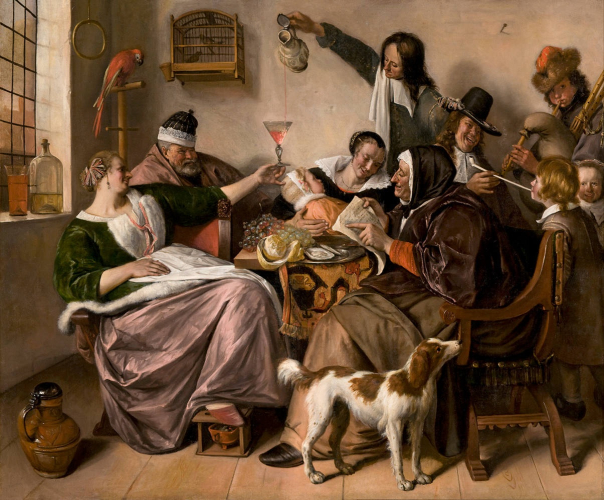
secondly, for the father's resolution to teach morals through stories. despite being a prosecutor whose job is entirely dependent on his rhetoric skills, he struggles to make a rational argument understandable to his son. but when he finally tells him a story of an emperor's child who dies early from smoking and sabotages his kingdom to ruin, the son promises never to smoke.
"he thought of the jurymen to whom it was absolutely necessary to make a 'speech,' of the general public who absorb history only from legends and historical novels, and of himself and how he had gathered an understanding of life not from sermons and laws, but from fables, novels, poems."
dutch genre painting was largely the protestant reformation's response to the abstractions of catholic art. an example used in class was Bosch's "seven deadly sins"; within the watchful eye of christ are immoral actions explicitely labelled according to their sin. genre painting, on the other hand, approached immorality as naturally repulsive, without the mediation of an authority who threatens punishment. a painting of fighting taverners could deter its viewer from drunkeness no matter their awareness of god's surveillance and judgement. like the father of chekhov's story says, "the modern teacher, taking his stand on logic, tries to make the child form good principles, not from fear, nor from desire for distinction or reward, but consciously."
however, some of Chekhov's stories aren't entirely without a mediator. "The Man in a Case," "Gooseberries," and "About Love" are all told within the narrative frame of friends telling each other stories, the same friends through all three. this reminded me of the medieval frame tales taught in a premodern literature course I took. in "Gooseberries," the narrator spirals into telling other stories -- that of a merchant who ate his money before he died and of an amputated man who worried for the money he kept in the boot of his lost leg -- within his larger story of his greedy brother. I thought of the introduction to "Thousand and One Nights" in the Norton Anthology of World Literature assigned in class:
"Which is the original version? When was it composed? Is The Thousand and One Nights an Arab text? A Persian Text? Indian? These questions ultimately slip away, because what the text is turns out to be much less interesting than what it does. The Thousand and One Nights has its life in transit--always becoming something new, leaving its reader in a perpetual state of anticipation. It is less a collection of stories than a machine that makes stories possible."
the deleuzo-guattarian machine appealed to me -- short stories as story-machines as opposed to the totality of the novel.